My Baby Was Born With a Holrby Her Ear
On this page:
- Why is it important to have my baby'due south hearing screened early on?
- When volition my baby's hearing be screened?
- How will my baby'due south hearing be screened?
- What should I do if my baby'due south hearing screening reveals potential hearing loss?
- The follow-upwardly exam revealed that my baby's hearing is fine. Does that hateful we don't demand to check his or her hearing once again?
- How can I assist my kid with hearing loss develop language skills?
- What devices could help my child hear and communicate better?
- What language and communication approaches are available for my child?
- Will my child be successful in school?
- Baby'south hearing screening and next steps: Timeline for parents
- Where can I find more than information most hearing screening and advice approaches?
Well-nigh children hear and heed to sounds at and even before birth. They learn to talk by imitating the sounds they hear around them and the voices of their parents and caregivers. Only that'due south non true for all children. In fact, about two or three out of every 1,000 children in the United States are born with detectable hearing loss in one or both ears. More than lose hearing later during childhood. Children who have hearing loss may not learn speech and language every bit well as children who can hear. For this reason, it's of import to detect hearing loss as early on equally possible.
Considering of the need for prompt identification of and intervention for childhood hearing loss, universal newborn hearing screening programs currently operate in all U.S. states and most U.S. territories. With assistance from the federal regime, every state has established an Early Hearing Detection and Intervention Programme. Equally a result, about 98% of babies have their hearing screened before one month of historic period.
Why is it important to accept my infant's hearing screened early?
The virtually important time for a child to learn linguistic communication (spoken or signed) is in the outset 3 years of life, when the encephalon is developing and maturing. In fact, children with typical hearing brainstorm learning speech communication and language in the commencement half-dozen months of life. This is why it is so important to screen and get-go interventions for hearing loss as early as possible. Enquiry shows that children with hearing loss who get help early develop ameliorate language skills than those who don't.
When volition my baby's hearing be screened?
Your baby's hearing should be screened before he or she leaves the hospital or birthing eye. If not, brand certain the baby is tested during the first calendar month of life. If your infant's hearing was not tested within 1 calendar month of birth, or if you oasis't been told the results of the hearing screening, ask your child's doc today. Quick action will exist important if the screening shows potential hearing loss.
How will my baby's hearing be screened?
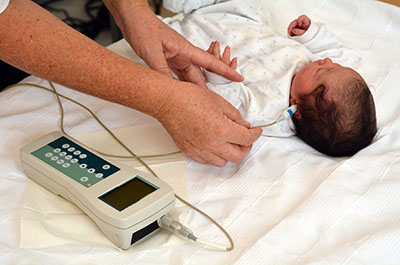
A newborn undergoes a hearing screening.
Two unlike tests are used to screen for hearing loss in babies. Your babe can rest or sleep during both tests.
- Otoacoustic emissions (OAE) tests whether some parts of the ear answer to sound. During this test, a soft earphone is inserted into your baby'south ear canal. Information technology plays sounds and measures an "repeat" response that occurs in ears with normal hearing. If at that place is no echo, your baby might have hearing loss.
- The auditory brain stem response (ABR) tests how the auditory nervus and encephalon stem (which deport sound from the ear to the brain) answer to sound. During this test, your baby wears small earphones and has electrodes painlessly placed on his or her head. The electrodes adhere and come off similar stickers and should not cause discomfort.
What should I do if my baby's hearing screening reveals potential hearing loss?
If the results show that your baby may have hearing loss, brand an appointment with a pediatric audiologist—a hearing expert who specializes in the cess and direction of children with hearing loss. This follow-up exam should be done as soon as possible, ideally by the time the babe is two to iii months old. The audiologist volition comport tests to determine whether your baby has a hearing problem and, if and so, the type and extent of that problem.
If you need help finding a pediatric audiologist, enquire your pediatrician or the hospital staff who conducted your babe's screening. They may even be able to assist yous schedule an engagement. You tin can also effort the directories provided past the American Academy of Audiology or the American Voice communication–Language–Hearing Association. If the follow-up exam confirms that your infant has hearing loss, he or she should begin receiving intervention services as soon equally possible, ideally past the age of 3 to 6 months. See our Baby's hearing screening and adjacent steps: Timeline for parents (below) for a guide to follow.
The pediatric audiologist may recommend that your baby visit a pediatric ear, nose, and throat (ENT) doctor who specializes in weather affecting the ear, known equally a pediatric otologist. A pediatric otologist tin decide possible causes of hearing loss and recommend intervention options. If your child has siblings, the audiologist or otologist may also recommend that their hearing be tested.
The follow-up examination revealed that my baby's hearing is fine. Does that hateful nosotros don't demand to check his or her hearing once again?
Not necessarily. Hearing loss can occur at whatsoever time of life. Some inherited forms of hearing loss don't appear until a child is older. If your baby was exposed to sure infections earlier being built-in, they are more than likely to have gradual hearing loss during childhood. Other factors, such as childhood affliction, ear infection, head injury, sure medications, and loud noise are also linked to hearing loss in children. Employ Your Infant's Hearing and Communicative Evolution Checklist to monitor and track your child'due south communication milestones through age 5. If you lot accept concerns about your kid'south hearing at any age, talk to your pediatrician right away.
How can I assist my kid with hearing loss develop language skills?
When interventions begin early on, children with hearing loss can develop language skills that aid them communicate freely and learn actively. The Individuals with Disabilities Education Human action ensures that all children with disabilities accept access to the services they demand to get a adept education. Your community may also offer additional services to help support your child.
Your babe's health care team will help yous detect services and methods to overcome communication barriers. You may also be referred to a oral communication-language pathologist or a teacher who is experienced in working with children with hearing loss. Talk to and communicate with your child often and stay upwards-to-date with all health care appointments.
What devices could assist my child hear and communicate better?
Depending on your baby's hearing loss and communication needs, some of these devices and tools may help to maximize his or her communication skills.
- Hearing aids. Worn behind the ear, hearing aids help make sounds louder and clearer. Hearing aids can be used for different degrees of hearing loss in babies every bit young as 1 calendar month. A pediatric audiologist who is experienced in treating infants and children can aid y'all cull the all-time hearing assist and brand sure that information technology fits securely and is properly adapted. Read the NIDCD fact canvas Hearing Aids for more information.
- Cochlear implants. If your child cannot do good from a hearing help, your doctor or audiologist may suggest a cochlear implant. This electronic device tin provide a sense of audio to people who are profoundly deaf or hard-of-hearing. The device converts sounds into electrical signals and carries them past the nonworking part of the inner ear to the brain. Cochlear implants tin can be surgically placed in children as young as 12 months, or sometimes earlier.
With training, children with cochlear implants tin can learn to recognize sounds and understand speech. Studies accept also shown that many eligible children who receive a cochlear implant early (before 18 months of historic period) can develop spoken linguistic communication skills at a charge per unit comparable to children with normal hearing, and many succeed in mainstream classrooms. Some doctors now recommend the use of 2 cochlear implants, one for each ear. An audiologist or otolaryngologist who specializes in cochlear implants can help you decide if a cochlear implant is advisable for your kid. Read the NIDCD fact sheet Cochlear Implants for more information.
- Assistive devices. As your child grows, other devices may be useful. Some devices assistance children hear ameliorate in a classroom. Others amplify one-on-one conversations or make talking on the phone or watching TV and videos easier. Read the NIDCD fact canvas Assistive Devices for People with Hearing, Voice, Spoken communication, or Linguistic communication Disorders for more information.
What language and communication approaches might exist bachelor for my child?
Children who are deaf or hard-of-hearing can learn to communicate in several means. Find out as much every bit you can about the communication choices and inquire your health care team to refer y'all to experts if you want to know more. Because language development begins early, regardless of the advice mode you cull, you should engage with your kid and begin intervention as soon as possible.
Common approaches used to assist children with hearing loss communicate and interact with others include:
- Listening and oral communication (likewise known equally auditory-verbal): works to strengthen listening, talking, and reading skills through the use of natural hearing and hearing devices such every bit hearing aids and cochlear implants, without the utilise of manual advice.
- Auditory-oral:emphasizes residual natural hearing in combination with distension devices and technology to assist children develop speech and spoken-language skills. Information technology includes the use of speech reading and natural gestures in the communication process.
- Cued speech: is a system of specific manus shapes and placements that stand for groups of consonants and vowels and that are used in combination with natural lip movements.
- American Sign Language: is a visual-manual, natural language that is used in the American Deafened community.
- Combined approaches: use aspects of various advice approaches, some of which are listed higher up, to expose children who are deaf or hard-of-hearing to many means to communicate with others.
Volition my child be successful in school?
Like all children, children who are deaf or difficult-of-hearing can develop strong academic, social, and emotional skills and succeed in school. Discover out how your school system helps children with hearing loss. With your input, your child's school will develop an Individualized Education Programme (IEP) or Individualized Family Service Program (IFSP) for your child, and you should ask if an educational audiologist is available to exist function of the academic team. Explore programs outside of school that may help you and your child and talk with other parents who have already dealt with these issues. The Individuals with Disabilities Education Deed ensures that children with hearing loss receive free, appropriate, early-intervention services from birth through the schoolhouse years. Contact the U.S. Section of Pedagogy, forth with resources listed in our directory of organizations.
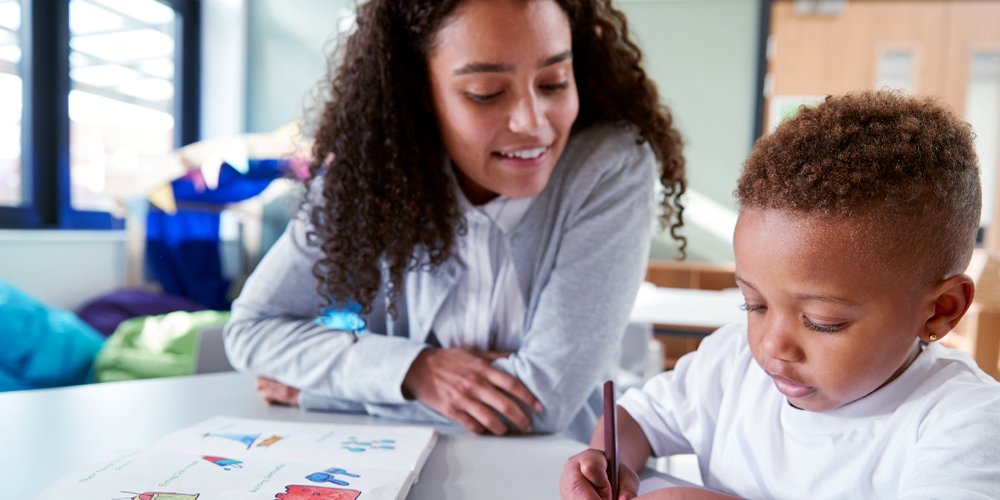
An educator teaching a immature boy.
Baby's hearing screening and side by side steps: Timeline for parents
Employ this timeline to get started.
| Make sure that your baby's hearing is screened either before you lot get out the infirmary or immediately later. After the screening, notice out the results. If your newborn was not screened in the hospital, schedule a screening to occur by the time your baby is one month onetime. |
| If your infant did not pass the hearing screening, immediately schedule a follow-up appointment with a pediatric audiologist. Ask your doctor or hospital for a list of pediatric audiologists, or employ the directories provided by the American Academy of Audiology and the American Oral communication–Linguistic communication–Hearing Association. | |
| If you must cancel the follow-up appointment, reschedule it!Make sure you accept your babe to a follow-up examination. This tin occur as early on equally 2 months after birth, and by historic period 3 months at the latest. |
| If the follow-upward exam shows that your baby has hearing loss, showtime your baby in some form of intervention every bit presently as possible. Your baby tin start receiving intervention services as early as 3 months later nascence and no subsequently than half dozen months. Interventions tin can include hearing devices, such as hearing aids or cochlear implants, and various language and advice approaches. Enquire your health intendance team about the options. |
| Remain active and involved in your child'southward progress. | |
| If y'all movement or change your contact information, make sure to tell your child's doctors and specialists. | |
| Even if the follow-up exam establish no sign of hearing loss in your child, go along to monitor his or her advice development. If you accept concerns, speak with your child'due south doctor. If your child has chance factors for childhood hearing loss, speak with an audiologist near how often his or her hearing should be monitored. |
Where can I find more information about hearing screening and advice approaches?
The NIDCD maintains a directory of organizations that provide information on the normal and disordered processes of hearing, balance, sense of taste, odor, voice, speech, and linguistic communication.
For more information, contact u.s. at:
NIDCD Information Clearinghouse
1 Communication Avenue
Bethesda, Doctor 20892-3456
Toll-gratis vocalism: (800) 241-1044
Toll-gratuitous TTY: (800) 241-1055
E-mail: nidcdinfo@nidcd.nih.gov
NIH Publication No. 21–4968
October 2021
*Note: PDF files crave a viewer such as the free Adobe Reader.
Source: https://www.nidcd.nih.gov/health/your-babys-hearing-screening-and-next-steps
0 Response to "My Baby Was Born With a Holrby Her Ear"
Post a Comment